
Disclaimer: What I share here is personal opinion and analysis and does not necessarily reflect my employer’s position or opinion. I was not going to share any of this publicly.. until yesterday.
Update 01 Sept 2012: If you’re interested in following this story further, please check out my site WhatIs3DayStartup.wordpress.com where I cover this situation in more detail.
I go to a lot of hackathons. No seriously, a LOT of hackathons. So far this year, I’ve mentored and/or organized Trojan Hacks in LA, API Hackday Austin, Code across America, DrupalCon Denver, Austin Startup Weekend, HackMU, Lean Startup Machine, php|tek, Random Hacks of Kindness, Sphero World Tour, DC Startup Weekend eGovernment, and next week API Hackday Dallas.
In every one of those cases, attending is as simple as registering. In some cases, you have to buy a ticket but none of those events require any sort of legal agreements.. and then there’s 3 Day Startup (aka 3DS).
The Vision behind 3 Day Startup is basically Startup Weekend for students:
The idea of 3 Day Startup is simple: start tech companies over the course of three days. We rent work space for an entire weekend, recruit 45 student participants from a wide range of backgrounds, cater food and drinks, and bring in top-notch entrepreneurs and investors. The participants pick the best ideas for startups during the Friday brainstorming session and deliver prototypes and investor pitches on Sunday night.
When I mentored at the 3 Day Startup in April, I heard a few people say things like “make sure you sign the agreement” which I initially thought was odd, but since HomeAway demo’d their still-internal-not-public API, I assumed it was an NDA. It would make sense. But since I’m nosy, I decided to grab a copy and read.
What I read was disturbing.
To be clear, I think NDA’s have a place. If you’re demo’ing a not-public product or new features, an NDA can give you a hammer in case the knuckleheads out there do something inappropriate. Does it protect you? Not really. Does it deter the mostly-honest people? Absolutely.
The agreement I read was NOT an NDA.
Instead it was an agreement that transfered ownership of ALL documents, code, ideas, etc to the 3 Day Startup organization. Even worse, I didn’t see any limitations that it only covered material created at the event. Frankly, I was so shocked I decided not to come back on Sunday.
Having some time to stop and think, I assumed I misread it, so I started digging. I reached out to one of their board members to get clarification. He referred me to the organizers. I expressed my concerns (politely even!) and asked for a copy of the agreement for review. So when they sent me the agreement, I found this key quote:
No.. wait… they refused to send me a copy of the agreement.
That’s right. I asked for a copy of the agreement from three separate organizers and every single one refused to send it and defended the current structure. I discussed the matter with a few trusted friends, hackers, and colleagues and decided to not get involved in 3DS and quietly let the matter rest.
And then a month later, I get another email asking to discuss it. I ask for a copy of the agreement. The discussion died after a few days.
And then a month later (last week), I get another email asking to discuss it. I finally set up a time to chat and when it’s canceled at the last minute, I rethink it and respond with:
There’s no way we can have a useful conversation about agreement(s) that you know in detail and I’m not even allowed to see. It may be what I think or I may have misread it and this is a non-issue. Either way, it’s a waste of both of our time as is.
Despite the harsh tone, I’m still trying to give them the benefit of the doubt and I was ready to let it drop again. And that’s when I was lied to:
To be clear, this isn’t a document you or Twilio would sign.
And I don’t say “lie” lightly, here is a screencap from their public FAQ:
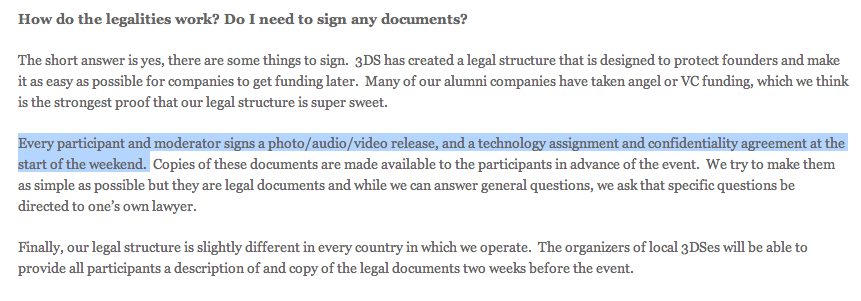
Combine that with the fact that I’ve heard of numerous groups considering 3 Day Startup events, I wanted this experience and the implications documented.
So for those who don’t understand my concerns, let me highlight them here:
I believe IP agreements like this are morally reprehensible. To claim “ownership” of anything I think of simply because I thought of it is disgusting. As a software developer, my entire job is to think of things. I don’t have control when I come up with a solution, so to consider that they might own it because I think of it during that weekend… is disgusting.
I believe it puts the students at risk. In my – admittedly short – review, there were no exceptions to the agreement and the boundaries were vaguely defined as “the weekend.” Therefore, if a student did homework over the weekend, does 3DS own it? Or what about other ideas they came up with over the weekend? I know of at least one group with paying customers and two more actively looking for funding and none of them were aware of the details of the contract.
I believe there are minimal safeguards for the students. As noted in the above screenshot, any specific questions should be “directed to one’s own lawyer.” How many college students have lawyers qualified (aka not law students) available to review this contract?
I believe the students don’t understand the implications. I counted no less than three groups who coordinated their work via public Github accounts. Did they have authorization to release 3DS’s intellectual property to the world?
I believe it could open me personally to legal liability. I advised and discussed ideas with a number of groups that weekend before I knew the details of the agreement. I had given similar advice at Austin Startup Weekend two weeks before and at Lean Startup Machine the following week. To think that 3DS now owns that content means… what exactly?
I believe it could open my customers, projects, etc to legal liability. I advise customers and community members constantly. If I had signed the agreement and responded to customer email, wrote a patch to my open source project, or advised anyone else of anything, would 3DS own it?
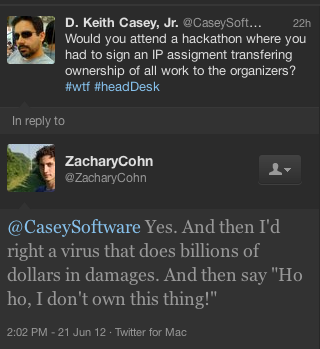 I believe it could open 3DS to legal liability. When I tweeted a question about this yesterday, I ended up with the response to the right. I’ll leave you to draw the conclusions.
I don’t want that practice associated with Twilio. We love getting involved at hackathons, hack weekends, hackity hack hacks and we’re well respected as being honest community-focused players. It is a trust and respect built by many people I personally admire and respect. I’m not willing to risk it.
I’m not sure the partners know the details. I’ve spoken with handful of 3DS groups that didn’t know of these agreements. That said, since 3DS owns everything created at the HomeAway weekend, they could have quietly transfered all ownership to HomeAway behind the scenes. Honestly, I don’t know.
I believe it is against the hacker ethos.
The whole point of these weekends is to step out of your shell, get to know the “other side” of a business, and generally learn and explore. When the results of anything I do will be owned someone else, it discourages experimentation. I have seen amazing successes and failures come out of hackathons but every single one taught someone something.. even if it’s “don’t do that.”
My overall point:
We live in a society driven by experimentation, exploration, innovation, sometimes screwing up royally, and sometimes discovering something amazing.. and you get the consequences good or bad. And that’s good. When you claim ownership of the product of someone’s mind simply because they happen to have signed up for your event, that stiffles it. I’m not a fan of IP agreements in jobs, but at least in those scenarios, you’re getting paid and the intentions are clear.